

'%20transform='matrix(4%200%200%204%20-40%200)'%3e%3cpath%20fill='%2309f'%20d='M0%200h180v120H0z'/%3e%3cpath%20fill='%23090'%20d='M0%200h180L0%20120z'/%3e%3cpath%20fill='%23000001'%20d='M0%20120h40l140-95V0h-40L0%2095z'/%3e%3cpath%20fill='%23ff0'%20d='M0%2091.5%20137.2%200h13.5L0%20100.5zM29.3%20120%20180%2019.5v9L42.8%20120z'/%3e%3c/g%3e%3c/svg%3e)


By Correspondent
THE TANZANIA Communications Regulatory Authority (TCRA) has intensified its support for national initiatives that promote information and communications technologies (ICT) and science and mathematics.
TCRA Director General, Eng. Peter Mwasalyanda said at the weekend that the Government through TCRA has established a total of 800 digital clubs throughout the country and Tanzanian students have been excelling in international mathematics competitions.
He said in boost of Government drive towards building a digital literate Country, TCRA sponsors Tanzania’s participation in continental and global secondary school mathematics competitions and digital clubs in schools. The Authority also supports the Tanzania Mathematical Association (TMA/CHAHITA), which coordinates the events.
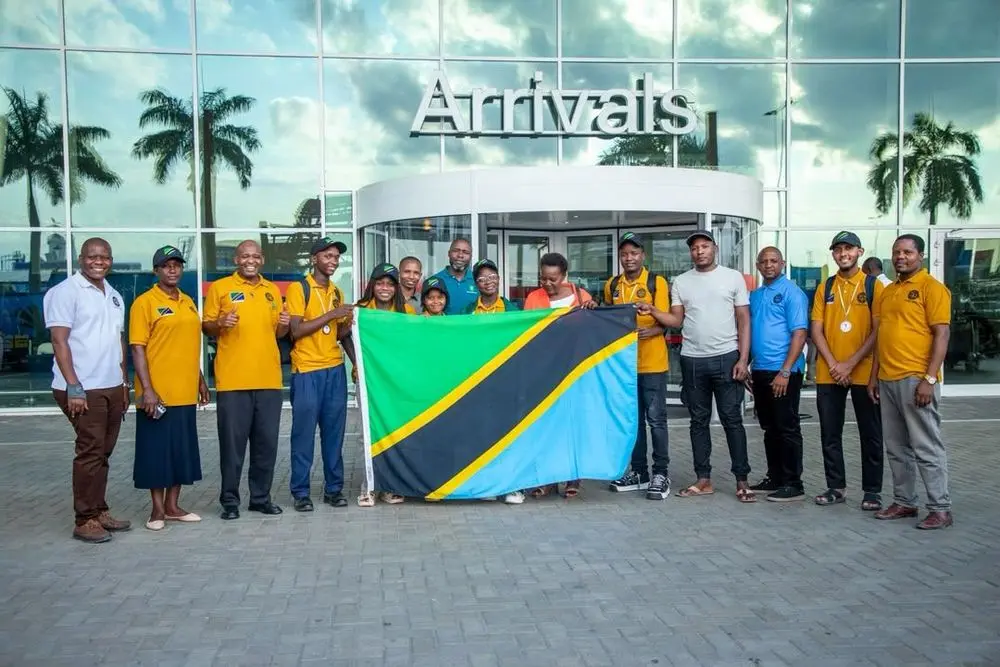
Eng. Mwasalyanda congratulated six students for successfully parading the National Flag at International level through their exemplary performance at the 2026 Pan African Mathematics Olympiad (PAMO) in Yamoussoukro, Ivory Coast last month, and the recent International Mathematics Olympiads in Shanghai, China.
Speaking on arrival at the Julius Nyerere International Airport in Dar Es Salaam yesterday, the Chairman of Mathematical Association of Tanzania Dr. Saidi Sima said that Tanzania’s participants at the Shanghai competition earned additional points, raising the country’s global ranking. They got 22 points compared with last year's 14.
Dr Sima who is also a lecturer at the University of Dar es Salaam said that a scholar, Ms Lightness Pigiliano Ngiliule of St Francis Secondary School has been awarded a medal as Africa’s Mathematics Queen. She won this title in Yamoussoukro.
Lightness was among six Tanzanian students who also participated in this year's PAMO. They are Angel Margaret Zalwango of White Lake Secondary School, Sweetbert John Nene of Ilboru, Nyandahu Theophil Leonard of Kibaha, Joyce Pascali Sulumo of Kilakala and Arqam Yassir Salim of Rehema Wakfu School.
Dr. sima expressed gratitude thanking TCRA for continuous support, saying a total of 9 medals were scooped and brought home, when Six Tanzanian secondary school students competed and won at PAMO Yamoussoukro, Ivory Coast last month, where the country emerged fifth among 26 competing countries. Three boys won a medal each while three girls grabbed two each in the general category. The girls won additional medals in the Girls category.
Science and Mathematics are crucial building blocks of a digital economy. When grouped with technology and engineering, these are referred to as STEM subjects.
STEM benefits nations and individual students. Besides facilitating a digital economy, these subjects equip students with knowledge and skills to build careers in the ever-changing ICT environment where technological advances will eliminate many existing jobs within a few years.
According to the TCRA Director General Eng. Mwasalyanda, TCRA promotes establishment of The digital clubs, right-away from nursery school to university levels, are intended to empower students to grasp digital technologies and their practical applications from a formative age. They cultivate digital skills and encourage the adoption of digital technology and culture across various sectors.
The clubs will enable youths to engage in ICT and communications issues; activities may include debates and competitions on various themes.
Tanzania’s Digital Economy Strategic Framework (2024-2034) reiterates the need to raise awareness of STEM from lower education levels. It urges stakeholders to promote digital literacy and skills as key enablers of a digital economy.
“It is essential to integrate digital literacy and critical thinking skills into the standard educational curriculum from lower educational levels, covering digital content like coding, data analysis, digital citizenship, and media literacy.”, the framework emphasizes.
Education experts estimate that only 25 per cent of students in most African countries pursue STEM-related career fields in higher education.
Barriers include inadequate facilities, fewer teachers and misconceptions about STEM difficulties. Most schools lack facilities for practicals, including equipped laboratories.